Mao Zedong[a] (December 26, 1893 – September 9, 1976), also known as Chairman Mao, was a Chinese communist revolutionarywho was the founder of the People's Republic of China (PRC), which he led as the chairman of the Chinese Communist Party from the establishment of the PRC in 1949 until his death in 1976. Ideologically a Marxist–Leninist, his theories, military strategies, and political policies are collectively known as Maoism.



Mao was the son of a prosperous peasant in Shaoshan, Hunan. He supported Chinese nationalism and had an anti-imperialistoutlook early in his life, and was particularly influenced by the events of the Xinhai Revolution of 1911 and May Fourth Movementof 1919. He later adopted Marxism–Leninism while working at Peking University as a librarian and became a founding member of the Chinese Communist Party (CCP), leading the Autumn Harvest Uprising in 1927. During the Chinese Civil War between the Kuomintang(KMT) and the CCP, Mao helped to found the Chinese Workers' and Peasants' Red Army, led the Jiangxi Soviet's radical land policies, and ultimately became head of the CCP during the Long March. Although the CCP temporarily allied with the KMT under the Second United Front during the Second Sino-Japanese War(1937–1945), China's civil war resumed after Japan's surrender, and Mao's forces defeated the Nationalist government, which withdrew to Taiwan in 1949.
On October 1, 1949, Mao proclaimed the foundation of the PRC, a Marxist–Leninist single-party state controlled by the CCP. In the following years he solidified his control through the Chinese Land Reform against landlords, the Campaign to Suppress Counterrevolutionaries, the "Three-anti and Five-anti Campaigns", and through a psychological victory in the Korean War, which altogether resulted in the deaths of several million Chinese. From 1953 to 1958, Mao played an important role in enforcing planned economy in China, constructing the first Constitution of the PRC, launching the industrialisation program, and initiating military projects such as the "Two Bombs, One Satellite" project and Project 523. His foreign policies during this time were dominated by the Sino-Soviet split which drove a wedge between China and the Soviet Union. In 1955, Mao launched the Sufan movement, and in 1957 he launched the Anti-Rightist Campaign, in which at least 550,000 people, mostly intellectuals and dissidents, were persecuted. In 1958, he launched the Great Leap Forwardthat aimed to rapidly transform China's economy from agrarian to industrial, which led to the deadliest famine in history and the deaths of 15–55 million people between 1958 and 1962. In 1963, Mao launched the Socialist Education Movement, and in 1966 he initiated the Cultural Revolution, a program to remove "counter-revolutionary" elements in Chinese society which lasted 10 years and was marked by violent class struggle, widespread destruction of cultural artifacts, and an unprecedented elevation of Mao's cult of personality. Tens of millions of people were persecuted during the Revolution, while the estimated number of deaths ranges from hundreds of thousands to millions. After years of ill health, Mao suffered a series of heart attacks in 1976 and died at the age of 82. During Mao's era, China's population grew from around 550 million to over 900 million while the government did not strictly enforce its family planning policy.
A controversial figure within and outside China, Mao is still regarded as one of the most important individuals in the twentieth century. Beyond politics, Mao is also known as a theorist, military strategist, and poet. During the Mao era, China was heavily involved with other southeast Asian communist conflicts such as the Korean War, the Vietnam War, and the Cambodian Civil War, which brought the Khmer Rouge to power. He ruled China through an autocratic and totalitarian regime responsible for mass repression as well as destruction of religious and cultural artifacts and sites.[2] The government was responsible for vast numbers of deaths with estimates ranging from 40 to 80 million victims through starvation, persecution, prison labour, and mass executions.[3][4][5][6] Mao has been praised for transforming China from a semi-colony to a leading world power, with greatly advanced literacy, women's rights, basic healthcare, primary education and life expectancy.[7][8][9][10]
English romanisation of name
During Mao's lifetime, the English-language media universally rendered his name as Mao Tse-tung, using the Wade-Giles system of transliteration for Standard Chinese though with the circumflex accent in the syllable Tsêdropped. Due to its recognizability, the spelling was used widely, even by the Foreign Ministry of the PRC after Hanyu Pinyinbecame the PRC's official romanisation system for Mandarin Chinese in 1958; the well-known booklet of Mao's political statements, The Little Red Book, was officially entitled Quotations from Chairman Mao Tse-tung in English translations. While the pinyin-derived spelling Mao Zedong is increasingly common, the Wade-Giles-derived spelling Mao Tse-tungcontinues to be used in modern publications to some extent.[11]
Early life
Youth and the Xinhai Revolution: 1893–1911
Mao was born on December 26, 1893, in Shaoshan village, Hunan.[12] His father, Mao Yichang, was a formerly impoverished peasant who had become one of the wealthiest farmers in Shaoshan. Growing up in rural Hunan, Mao described his father as a stern disciplinarian, who would beat him and his three siblings, the boys Zemin and Zetan, as well as an adopted girl, Zejian.[13] Mao's mother, Wen Qimei, was a devout Buddhist who tried to temper her husband's strict attitude.[14] Mao too became a Buddhist, but abandoned this faith in his mid-teenage years.[14] At age 8, Mao was sent to Shaoshan Primary School. Learning the value systems of Confucianism, he later admitted that he did not enjoy the classical Chinese texts preaching Confucian morals, instead favouring classic novels like Romance of the Three Kingdoms and Water Margin.[15]At age 13, Mao finished primary education, and his father united him in an arranged marriage to the 17-year-old Luo Yixiu, thereby uniting their land-owning families. Mao refused to recognise her as his wife, becoming a fierce critic of arranged marriage and temporarily moving away. Luo was locally disgraced and died in 1910, at only 21 years old.[16]

While working on his father's farm, Mao read voraciously[17] and developed a "political consciousness" from Zheng Guanying's booklet which lamented the deterioration of Chinese power and argued for the adoption of representative democracy.[18] Interested in history, Mao was inspired by the military prowess and nationalistic fervour of George Washington and Napoleon Bonaparte.[19] His political views were shaped by Gelaohui-led protests which erupted following a famine in Changsha, the capital of Hunan; Mao supported the protesters' demands, but the armed forces suppressed the dissenters and executed their leaders.[20] The famine spread to Shaoshan, where starving peasants seized his father's grain. He disapproved of their actions as morally wrong, but claimed sympathy for their situation.[21] At age 16, Mao moved to a higher primary school in nearby Dongshan,[22] where he was bullied for his peasant background.[23]
In 1911, Mao began middle school in Changsha.[24] Revolutionary sentiment was strong in the city, where there was widespread animosity towards Emperor Puyi's absolute monarchy and many were advocating republicanism. The republicans' figurehead was Sun Yat-sen, an American-educated Christian who led the Tongmenghui society.[25]In Changsha, Mao was influenced by Sun's newspaper, The People's Independence (Minli bao),[26] and called for Sun to become president in a school essay.[27] As a symbol of rebellion against the Manchu monarch, Mao and a friend cut off their queue pigtails, a sign of subservience to the emperor.[28]
Inspired by Sun's republicanism, the army rose up across southern China, sparking the Xinhai Revolution. Changsha's governor fled, leaving the city in republican control.[29] Supporting the revolution, Mao joined the rebel army as a private soldier, but was not involved in fighting. The northern provinces remained loyal to the emperor, and hoping to avoid a civil war, Sun—proclaimed "provisional president" by his supporters—compromised with the monarchist general Yuan Shikai. The monarchy was abolished, creating the Republic of China, but the monarchist Yuan became president. The revolution over, Mao resigned from the army in 1912, after six months as a soldier.[30] Around this time, Mao discovered socialism from a newspaper article; proceeding to read pamphlets by Jiang Kanghu, the student founder of the Chinese Socialist Party, Mao remained interested yet unconvinced by the idea.[31]
Fourth Normal School of Changsha: 1912–1919
Over the next few years, Mao Zedong enrolled and dropped out of a police academy, a soap-production school, a law school, an economics school, and the government-run Changsha Middle School.[32] Studying independently, he spent much time in Changsha's library, reading core works of classical liberalism such as Adam Smith's The Wealth of Nations and Montesquieu's The Spirit of the Laws, as well as the works of western scientists and philosophers such as Darwin, Mill, Rousseau, and Spencer.[33] Viewing himself as an intellectual, years later he admitted that at this time he thought himself better than working people.[34] He was inspired by Friedrich Paulsen, a neo-Kantian philosopher and educator whose emphasis on the achievement of a carefully defined goal as the highest value led Mao to believe that strong individuals were not bound by moral codes but should strive for a great goal.[35]His father saw no use in his son's intellectual pursuits, cut off his allowance and forced him to move into a hostel for the destitute.[36]
Mao desired to become a teacher and enrolled at the Fourth Normal School of Changsha, which soon merged with the First Normal School of Hunan, widely seen as the best in Hunan.[37] Befriending Mao, professor Yang Changji urged him to read a radical newspaper, New Youth (Xin qingnian), the creation of his friend Chen Duxiu, a dean at Peking University. Although he was a supporter of Chinese nationalism, Chen argued that China must look to the west to cleanse itself of superstition and autocracy.[38] In his first school year, Mao befriended an older student, Xiao Zisheng; together they went on a walking tour of Hunan, begging and writing literary couplets to obtain food.[39]
A popular student, in 1915 Mao was elected secretary of the Students Society. He organised the Association for Student Self-Government and led protests against school rules.[40] Mao published his first article in New Youth in April 1917, instructing readers to increase their physical strength to serve the revolution.[41] He joined the Society for the Study of Wang Fuzhi (Chuan-shan Hsüeh-she), a revolutionary group founded by Changsha literati who wished to emulate the philosopher Wang Fuzhi.[42] In spring 1917, he was elected to command the students' volunteer army, set up to defend the school from marauding soldiers.[43] Increasingly interested in the techniques of war, he took a keen interest in World War I, and also began to develop a sense of solidarity with workers.[44] Mao undertook feats of physical endurance with Xiao Zisheng and Cai Hesen, and with other young revolutionaries they formed the Renovation of the People Study Society in April 1918 to debate Chen Duxiu's ideas. Desiring personal and societal transformation, the Society gained 70–80 members, many of whom would later join the Communist Party.[45] Mao graduated in June 1919, ranked third in the year.[46]
Early revolutionary activity
Beijing, anarchism, and Marxism: 1917–1919
Mao moved to Beijing, where his mentor Yang Changji had taken a job at Peking University.[47] Yang thought Mao exceptionally "intelligent and handsome",[48] securing him a job as assistant to the university librarian Li Dazhao, who would become an early Chinese Communist.[49] Li authored a series of New Youth articles on the October Revolution in Russia, during which the Communist Bolshevik Party under the leadership of Vladimir Leninhad seized power. Lenin was an advocate of the socio-political theory of Marxism, first developed by the German sociologists Karl Marx and Friedrich Engels, and Li's articles added Marxism to the doctrines in Chinese revolutionary movement.[50]
Becoming "more and more radical", Mao was initially influenced by Peter Kropotkin's anarchism, which was the most prominent radical doctrine of the day. Chinese anarchists, such as Cai Yuanpei, Chancellor of Peking University, called for complete social revolution in social relations, family structure, and women's equality, rather than the simple change in the form of government called for by earlier revolutionaries. He joined Li's Study Group and "developed rapidly toward Marxism" during the winter of 1919.[51]Paid a low wage, Mao lived in a cramped room with seven other Hunanese students, but believed that Beijing's beauty offered "vivid and living compensation".[52] A number of his friends took advantage of the anarchist-organised Mouvement Travail-Études to study in France, but Mao declined, perhaps because of an inability to learn languages.[53]
At the university, Mao was snubbed by other students due to his rural Hunanese accent and lowly position. He joined the university's Philosophy and Journalism Societies and attended lectures and seminars by the likes of Chen Duxiu, Hu Shih, and Qian Xuantong.[54]Mao's time in Beijing ended in the spring of 1919, when he travelled to Shanghai with friends who were preparing to leave for France.[55] He did not return to Shaoshan, where his mother was terminally ill. She died in October 1919 and her husband died in January 1920.[56]
New Culture and political protests, 1919–1920
On May 4, 1919, students in Beijing gathered at the Tiananmen to protest the Chinese government's weak resistance to Japanese expansion in China. Patriots were outraged at the influence given to Japan in the Twenty-One Demands in 1915, the complicity of Duan Qirui's Beiyang Government, and the betrayal of China in the Treaty of Versailles, wherein Japan was allowed to receive territories in Shandong which had been surrendered by Germany. These demonstrations ignited the nationwide May Fourth Movement and fuelled the New Culture Movement which blamed China's diplomatic defeats on social and cultural backwardness.[57]
In Changsha, Mao had begun teaching history at the Xiuye Primary School[58] and organising protests against the pro-Duan Governor of Hunan Province, Zhang Jingyao, popularly known as "Zhang the Venomous" due to his corrupt and violent rule.[59] In late May, Mao co-founded the Hunanese Student Association with He Shuheng and Deng Zhongxia, organising a student strike for June and in July 1919 began production of a weekly radical magazine, Xiang River Review (Xiangjiang pinglun). Using vernacular language that would be understandable to the majority of China's populace, he advocated the need for a "Great Union of the Popular Masses", strengthened trade unions able to wage non-violent revolution.[clarification needed] His ideas were not Marxist, but heavily influenced by Kropotkin's concept of mutual aid.[60]
Zhang banned the Student Association, but Mao continued publishing after assuming editorship of the liberal magazine New Hunan(Xin Hunan) and offered articles in popular local newspaper Justice (Ta Kung Po). Several of these advocated feminist views, calling for the liberation of women in Chinese society; Mao was influenced by his forced arranged-marriage.[61] In December 1919, Mao helped organise a general strike in Hunan, securing some concessions, but Mao and other student leaders felt threatened by Zhang, and Mao returned to Beijing, visiting the terminally ill Yang Changji.[62] Mao found that his articles had achieved a level of fame among the revolutionary movement, and set about soliciting support in overthrowing Zhang.[63]Coming across newly translated Marxist literature by Thomas Kirkup, Karl Kautsky, and Marx and Engels—notably The Communist Manifesto—he came under their increasing influence, but was still eclectic in his views.[64]
Mao visited Tianjin, Jinan, and Qufu,[65] before moving to Shanghai, where he worked as a laundryman and met Chen Duxiu, noting that Chen's adoption of Marxism "deeply impressed me at what was probably a critical period in my life". In Shanghai, Mao met an old teacher of his, Yi Peiji, a revolutionary and member of the Kuomintang (KMT), or Chinese Nationalist Party, which was gaining increasing support and influence. Yi introduced Mao to General Tan Yankai, a senior KMT member who held the loyalty of troops stationed along the Hunanese border with Guangdong. Tan was plotting to overthrow Zhang, and Mao aided him by organising the Changsha students. In June 1920, Tan led his troops into Changsha, and Zhang fled. In the subsequent reorganisation of the provincial administration, Mao was appointed headmaster of the junior section of the First Normal School. Now receiving a large income, he married Yang Kaihui, daughter of Yang Changji, in the winter of 1920.[66][67]
Founding the Chinese Communist Party: 1921–1922

The Chinese Communist Party was founded by Chen Duxiu and Li Dazhao in the French concession of Shanghai in 1921 as a study society and informal network. Mao set up a Changsha branch, also establishing a branch of the Socialist Youth Corps and a Cultural Book Society which opened a bookstore to propagate revolutionary literature throughout Hunan.[68] He was involved in the movement for Hunan autonomy, in the hope that a Hunanese constitution would increase civil liberties and make his revolutionary activity easier. When the movement was successful in establishing provincial autonomy under a new warlord, Mao forgot his involvement.[69] By 1921, small Marxist groups existed in Shanghai, Beijing, Changsha, Wuhan, Guangzhou, and Jinan; it was decided to hold a central meeting, which began in Shanghai on July 23, 1921. The first session of the National Congress of the Chinese Communist Party was attended by 13 delegates, Mao included. After the authorities sent a police spy to the congress, the delegates moved to a boat on South Lake near Jiaxing, in Zhejiang, to escape detection. Although Soviet and Cominterndelegates attended, the first congress ignored Lenin's advice to accept a temporary alliance between the Communists and the "bourgeois democrats" who also advocated national revolution; instead they stuck to the orthodox Marxist belief that only the urban proletariat could lead a socialist revolution.[70]
Mao was now party secretary for Hunan stationed in Changsha, and to build the party there he followed a variety of tactics.[71] In August 1921, he founded the Self-Study University, through which readers could gain access to revolutionary literature, housed in the premises of the Society for the Study of Wang Fuzhi, a Qing dynasty Hunanese philosopher who had resisted the Manchus.[71]He joined the YMCA Mass Education Movement to fight illiteracy, though he edited the textbooks to include radical sentiments.[72] He continued organising workers to strike against the administration of Hunan Governor Zhao Hengti.[73] Yet labour issues remained central. The successful and famous Anyuan coal mines strikes(contrary to later Party historians) depended on both "proletarian" and "bourgeois" strategies. Liu Shaoqi and Li Lisan and Mao not only mobilised the miners, but formed schools and cooperatives and engaged local intellectuals, gentry, military officers, merchants, Red Gang dragon heads and even church clergy.[74]
Mao claimed that he missed the July 1922 Second Congress of the Communist Party in Shanghai because he lost the address. Adopting Lenin's advice, the delegates agreed to an alliance with the "bourgeois democrats" of the KMT for the good of the "national revolution". Communist Party members joined the KMT, hoping to push its politics leftward.[75] Mao enthusiastically agreed with this decision, arguing for an alliance across China's socio-economic classes, and eventually rose to become propaganda chief of the KMT.[67] Mao was a vocal anti-imperialist and in his writings he lambasted the governments of Japan, the UK and US, describing the latter as "the most murderous of hangmen".[76]
Collaboration with the Kuomintang: 1922–1927
At the Third Congress of the Communist Party in Shanghai in June 1923, the delegates reaffirmed their commitment to working with the KMT. Supporting this position, Mao was elected to the Party Committee, taking up residence in Shanghai.[77] At the First KMT Congress, held in Guangzhou in early 1924, Mao was elected an alternate member of the KMT Central Executive Committee, and put forward four resolutions to decentralise power to urban and rural bureaus. His enthusiastic support for the KMT earned him the suspicion of Li Li-san, his Hunan comrade.[78]
In late 1924, Mao returned to Shaoshan, perhaps to recuperate from an illness. He found that the peasantry were increasingly restless and some had seized land from wealthy landowners to found communes. This convinced him of the revolutionary potential of the peasantry, an idea advocated by the KMT leftists but not the Communists.[79] He returned to Guangzhou to run the 6th term of the KMT's Peasant Movement Training Institute from May to September 1926.[80][81]The Peasant Movement Training Institute under Mao trained cadre and prepared them for militant activity, taking them through military training exercises and getting them to study basic left-wing texts.[82] In the winter of 1925, Mao fled to Guangzhou after his revolutionary activities attracted the attention of Zhao's regional authorities.[83]
When party leader Sun Yat-sen died in May 1925, he was succeeded by Chiang Kai-shek, who moved to marginalise the left-KMT and the Communists.[84] Mao nevertheless supported Chiang's National Revolutionary Army, who embarked on the Northern Expedition attack in 1926 on warlords.[85] In the wake of this expedition, peasants rose up, appropriating the land of the wealthy landowners, who were in many cases killed. Such uprisings angered senior KMT figures, who were themselves landowners, emphasising the growing class and ideological divide within the revolutionary movement.[86]
In March 1927, Mao appeared at the Third Plenum of the KMT Central Executive Committee in Wuhan, which sought to strip General Chiang of his power by appointing Wang Jingwei leader. There, Mao played an active role in the discussions regarding the peasant issue, defending a set of "Regulations for the Repression of Local Bullies and Bad Gentry", which advocated the death penalty or life imprisonment for anyone found guilty of counter-revolutionary activity, arguing that in a revolutionary situation, "peaceful methods cannot suffice".[87][88] In April 1927, Mao was appointed to the KMT's five-member Central Land Committee, urging peasants to refuse to pay rent. Mao led another group to put together a "Draft Resolution on the Land Question", which called for the confiscation of land belonging to "local bullies and bad gentry, corrupt officials, militarists and all counter-revolutionary elements in the villages". Proceeding to carry out a "Land Survey", he stated that anyone owning over 30 mou (four and a half acres), constituting 13% of the population, were uniformly counter-revolutionary. He accepted that there was great variation in revolutionary enthusiasm across the country, and that a flexible policy of land redistribution was necessary.[89]Presenting his conclusions at the Enlarged Land Committee meeting, many expressed reservations, some believing that it went too far, and others not far enough. Ultimately, his suggestions were only partially implemented.[90]
Civil War
Nanchang and Autumn Harvest Uprisings: 1927

Fresh from the success of the Northern Expedition against the warlords, Chiang turned on the Communists, who by now numbered in the tens of thousands across China. Chiang ignored the orders of the Wuhan-based left KMT government and marched on Shanghai, a city controlled by Communist militias. As the Communists awaited Chiang's arrival, he loosed the White Terror, massacring 5000 with the aid of the Green Gang.[88][91] In Beijing, 19 leading Communists were killed by Zhang Zuolin.[92][93] That May, tens of thousands of Communists and those suspected of being communists were killed, and the CCP lost approximately 15,000 of its 25,000 members.[93]
The CCP continued supporting the Wuhan KMT government, a position Mao initially supported,[93] but by the time of the CCP's Fifth Congress he had changed his mind, deciding to stake all hope on the peasant militia.[94] The question was rendered moot when the Wuhan government expelled all Communists from the KMT on July 15.[94] The CCP founded the Workers' and Peasants' Red Army of China, better known as the "Red Army", to battle Chiang. A battalion led by General Zhu De was ordered to take the city of Nanchang on August 1, 1927, in what became known as the Nanchang Uprising. They were initially successful, but were forced into retreat after five days, marching south to Shantou, and from there they were driven into the wilderness of Fujian.[94] Mao was appointed commander-in-chief of the Red Army and led four regiments against Changsha in the Autumn Harvest Uprising, in the hope of sparking peasant uprisings across Hunan. On the eve of the attack, Mao composed a poem—the earliest of his to survive—titled "Changsha". His plan was to attack the KMT-held city from three directions on September 9, but the Fourth Regiment deserted to the KMT cause, attacking the Third Regiment. Mao's army made it to Changsha, but could not take it; by September 15, he accepted defeat and with 1000 survivors marched east to the Jinggang Mountains of Jiangxi.[95][96]
Jung Chang and Jon Halliday claim that the uprising was in fact sabotaged by Mao to allow him to prevent a group of KMT soldiers from defecting to any other CCP leader.[97]Chang and Halliday also claim that Mao talked the other leaders (including Russian diplomats at the Soviet consulate in Changsha who, Chang and Halliday claim, had been controlling much of the CCP activity) into striking only at Changsha, then abandoning it. Chang and Halliday report a view sent to Moscow by the secretary of the Soviet Consulate in Changsha that the retreat was "the most despicable treachery and cowardice."[97]
Base in Jinggangshan: 1927–1928

革命不是請客吃飯,不是做文章,不是繪畫繡花,不能那樣雅緻,那樣從容不迫,文質彬彬,那樣溫良恭讓。革命是暴動,是一個階級推翻一個階級的暴烈的行動。
Revolution is not a dinner party, nor an essay, nor a painting, nor a piece of embroidery; it cannot be so refined, so leisurely and gentle, so temperate, kind, courteous, restrained and magnanimous. A revolution is an insurrection, an act of violence by which one class overthrows another.
— Mao, February 1927[98]
The CCP Central Committee, hiding in Shanghai, expelled Mao from their ranks and from the Hunan Provincial Committee, as punishment for his "military opportunism", for his focus on rural activity, and for being too lenient with "bad gentry". The more orthodox Communists especially regarded the peasants as backward and ridiculed Mao's idea of mobilizing them.[67] They nevertheless adopted three policies he had long championed: the immediate formation of Workers' councils, the confiscation of all land without exemption, and the rejection of the KMT. Mao's response was to ignore them.[99]He established a base in Jinggangshan City, an area of the Jinggang Mountains, where he united five villages as a self-governing state, and supported the confiscation of land from rich landlords, who were "re-educated" and sometimes executed. He ensured that no massacres took place in the region, and pursued a more lenient approach than that advocated by the Central Committee.[100] He proclaimed that "Even the lame, the deaf and the blind could all come in useful for the revolutionary struggle", he boosted the army's numbers,[101] incorporating two groups of bandits into his army, building a force of around 1,800 troops.[102] He laid down rules for his soldiers: prompt obedience to orders, all confiscations were to be turned over to the government, and nothing was to be confiscated from poorer peasants. In doing so, he moulded his men into a disciplined, efficient fighting force.[101]
敵進我退,
敵駐我騷,
敵疲我打,
敵退我追。
When the enemy advances, we retreat.
When the enemy rests, we harass him.
When the enemy avoids a battle, we attack.
When the enemy retreats, we advance.
— Mao's advice in combating the Kuomintang, 1928[103][104]
In spring 1928, the Central Committee ordered Mao's troops to southern Hunan, hoping to spark peasant uprisings. Mao was skeptical, but complied. They reached Hunan, where they were attacked by the KMT and fled after heavy losses. Meanwhile, KMT troops had invaded Jinggangshan, leaving them without a base.[105] Wandering the countryside, Mao's forces came across a CCP regiment led by General Zhu De and Lin Biao; they united, and attempted to retake Jinggangshan. They were initially successful, but the KMT counter-attacked, and pushed the CCP back; over the next few weeks, they fought an entrenched guerrilla war in the mountains.[103][106] The Central Committee again ordered Mao to march to south Hunan, but he refused, and remained at his base. Contrastingly, Zhu complied, and led his armies away. Mao's troops fended the KMT off for 25 days while he left the camp at night to find reinforcements. He reunited with the decimated Zhu's army, and together they returned to Jinggangshan and retook the base. There they were joined by a defecting KMT regiment and Peng Dehuai's Fifth Red Army. In the mountainous area they were unable to grow enough crops to feed everyone, leading to food shortages throughout the winter.[107][108]
In 1928, Mao met and married He Zizhen, an 18-year-old revolutionary who would bear him six children.[109][110]
Jiangxi Soviet Republic of China: 1929–1934
In January 1929, Mao and Zhu evacuated the base with 2,000 men and a further 800 provided by Peng, and took their armies south, to the area around Tonggu and Xinfeng in Jiangxi.[111] The evacuation led to a drop in morale, and many troops became disobedient and began thieving; this worried Li Lisan and the Central Committee, who saw Mao's army as lumpenproletariat, that were unable to share in proletariat class consciousness.[112][113] In keeping with orthodox Marxist thought, Li believed that only the urban proletariat could lead a successful revolution, and saw little need for Mao's peasant guerrillas; he ordered Mao to disband his army into units to be sent out to spread the revolutionary message. Mao replied that while he concurred with Li's theoretical position, he would not disband his army nor abandon his base.[113][114] Both Li and Mao saw the Chinese revolution as the key to world revolution, believing that a CCP victory would spark the overthrow of global imperialism and capitalism. In this, they disagreed with the official line of the Soviet government and Comintern. Officials in Moscow desired greater control over the CCP and removed Li from power by calling him to Russia for an inquest into his errors.[115][116][117] They replaced him with Soviet-educated Chinese Communists, known as the "28 Bolsheviks", two of whom, Bo Gu and Zhang Wentian, took control of the Central Committee. Mao disagreed with the new leadership, believing they grasped little of the Chinese situation, and he soon emerged as their key rival.[116][118]

In February 1930, Mao created the Southwest Jiangxi Provincial Soviet Government in the region under his control.[119] In November, he suffered emotional trauma after his second wife Yang Kaihui and sister were captured and beheaded by KMT general He Jian.[108][116][120]Facing internal problems, members of the Jiangxi Soviet accused him of being too moderate, and hence anti-revolutionary. In December, they tried to overthrow Mao, resulting in the Futian incident, during which Mao's loyalists tortured many and executed between 2000 and 3000 dissenters.[121][122][123]The CCP Central Committee moved to Jiangxi which it saw as a secure area. In November, it proclaimed Jiangxi to be the Soviet Republic of China, an independent Communist-governed state. Although he was proclaimed Chairman of the Council of People's Commissars, Mao's power was diminished, as his control of the Red Army was allocated to Zhou Enlai. Meanwhile, Mao recovered from tuberculosis.[124][125]
The KMT armies adopted a policy of encirclement and annihilation of the Red armies. Outnumbered, Mao responded with guerrilla tactics influenced by the works of ancient military strategists like Sun Tzu, but Zhou and the new leadership followed a policy of open confrontation and conventional warfare. In doing so, the Red Army successfully defeated the first and second encirclements.[126][127] Angered at his armies' failure, Chiang Kai-shek personally arrived to lead the operation. He too faced setbacks and retreated to deal with the further Japanese incursions into China.[124][128] As a result of the KMT's change of focus to the defence of China against Japanese expansionism, the Red Army was able to expand its area of control, eventually encompassing a population of 3 million.[127] Mao proceeded with his land reform program. In November 1931 he announced the start of a "land verification project" which was expanded in June 1933. He also orchestrated education programs and implemented measures to increase female political participation.[129]Chiang viewed the Communists as a greater threat than the Japanese and returned to Jiangxi, where he initiated the fifth encirclement campaign, which involved the construction of a concrete and barbed wire "wall of fire" around the state, which was accompanied by aerial bombardment, to which Zhou's tactics proved ineffective. Trapped inside, morale among the Red Army dropped as food and medicine became scarce. The leadership decided to evacuate.[130]
Long March: 1934–1935
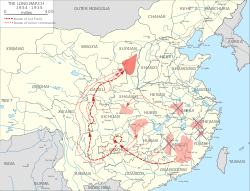
On October 14, 1934, the Red Army broke through the KMT line on the Jiangxi Soviet's south-west corner at Xinfeng with 85,000 soldiers and 15,000 party cadres and embarked on the "Long March". In order to make the escape, many of the wounded and the ill, as well as women and children, were left behind, defended by a group of guerrilla fighters whom the KMT massacred.[131][132] The 100,000 who escaped headed to southern Hunan, first crossing the Xiang River after heavy fighting,[132][133] and then the Wu River, in Guizhou where they took Zunyi in January 1935. Temporarily resting in the city, they held a conference; here, Mao was elected to a position of leadership, becoming Chairman of the Politburo, and de facto leader of both Party and Red Army, in part because his candidacy was supported by Soviet Premier Joseph Stalin. Insisting that they operate as a guerrilla force, he laid out a destination: the Shenshi Soviet in Shaanxi, Northern China, from where the Communists could focus on fighting the Japanese. Mao believed that in focusing on the anti-imperialist struggle, the Communists would earn the trust of the Chinese people, who in turn would renounce the KMT.[134]
From Zunyi, Mao led his troops to Loushan Pass, where they faced armed opposition but successfully crossed the river. Chiang flew into the area to lead his armies against Mao, but the Communists outmanoeuvred him and crossed the Jinsha River.[135] Faced with the more difficult task of crossing the Tatu River, they managed it by fighting a battle over the Luding Bridge in May, taking Luding.[136]Marching through the mountain ranges around Ma'anshan,[137] in Moukung, Western Szechuan, they encountered the 50,000-strong CCP Fourth Front Army of Zhang Guotao, and together proceeded to Maoerhkai and then Gansu. Zhang and Mao disagreed over what to do; the latter wished to proceed to Shaanxi, while Zhang wanted to retreat east to Tibet or Sikkim, far from the KMT threat. It was agreed that they would go their separate ways, with Zhu De joining Zhang.[138] Mao's forces proceeded north, through hundreds of kilometres of Grasslands, an area of quagmire where they were attacked by Manchu tribesman and where many soldiers succumbed to famine and disease.[139][140]Finally reaching Shaanxi, they fought off both the KMT and an Islamic cavalry militia before crossing the Min Mountains and Mount Liupan and reaching the Shenshi Soviet; only 7,000–8000 had survived.[140][141] The Long March cemented Mao's status as the dominant figure in the party. In November 1935, he was named chairman of the Military Commission. From this point onward, Mao was the Communist Party's undisputed leader, even though he would not become party chairman until 1943.[142]
Alliance with the Kuomintang: 1935–1940

Mao's troops arrived at the Yan'an Soviet during October 1935 and settled in Pao An, until spring 1936. While there, they developed links with local communities, redistributed and farmed the land, offered medical treatment, and began literacy programs.[140][143][144] Mao now commanded 15,000 soldiers, boosted by the arrival of He Long's men from Hunan and the armies of Zhu De and Zhang Guotao returned from Tibet.[143]In February 1936, they established the North West Anti-Japanese Red Army University in Yan'an, through which they trained increasing numbers of new recruits.[145] In January 1937, they began the "anti-Japanese expedition", that sent groups of guerrilla fighters into Japanese-controlled territory to undertake sporadic attacks.[146][147] In May 1937, a Communist Conference was held in Yan'an to discuss the situation.[148] Western reporters also arrived in the "Border Region" (as the Soviet had been renamed); most notable were Edgar Snow, who used his experiences as a basis for Red Star Over China, and Agnes Smedley, whose accounts brought international attention to Mao's cause.[149]
On the Long March, Mao's wife He Zizen had been injured by a shrapnel wound to the head. She travelled to Moscow for medical treatment; Mao proceeded to divorce her and marry an actress, Jiang Qing.[150][151] He Zizhen was reportedly "dispatched to a mental asylum in Moscow to make room" for Qing.[152]Mao moved into a cave-house and spent much of his time reading, tending his garden and theorising.[153] He came to believe that the Red Army alone was unable to defeat the Japanese, and that a Communist-led "government of national defence" should be formed with the KMT and other "bourgeois nationalist" elements to achieve this goal.[154]Although despising Chiang Kai-shek as a "traitor to the nation",[155] on May 5, he telegrammed the Military Council of the Nanking National Government proposing a military alliance, a course of action advocated by Stalin.[156] Although Chiang intended to ignore Mao's message and continue the civil war, he was arrested by one of his own generals, Zhang Xueliang, in Xi'an, leading to the Xi'an Incident; Zhang forced Chiang to discuss the issue with the Communists, resulting in the formation of a United Front with concessions on both sides on December 25, 1937.[157]
The Japanese had taken both Shanghai and Nanking (Nanjing)—resulting in the Nanking Massacre, an atrocity Mao never spoke of all his life—and was pushing the Kuomintang government inland to Chungking.[158] The Japanese's brutality led to increasing numbers of Chinese joining the fight, and the Red Army grew from 50,000 to 500,000.[159][160]In August 1938, the Red Army formed the New Fourth Army and the Eighth Route Army, which were nominally under the command of Chiang's National Revolutionary Army.[161] In August 1940, the Red Army initiated the Hundred Regiments Campaign, in which 400,000 troops attacked the Japanese simultaneously in five provinces. It was a military success that resulted in the death of 20,000 Japanese, the disruption of railways and the loss of a coal mine.[160][162] From his base in Yan'an, Mao authored several texts for his troops, including Philosophy of Revolution, which offered an introduction to the Marxist theory of knowledge; Protracted Warfare, which dealt with guerrilla and mobile military tactics; and New Democracy, which laid forward ideas for China's future.[163]
Resuming civil war: 1940–1949
In 1944, the U.S. sent a special diplomatic envoy, called the Dixie Mission, to the Chinese Communist Party. The American soldiers who were sent to the mission were favourably impressed. The party seemed less corrupt, more unified, and more vigorous in its resistance to Japan than the Kuomintang. The soldiers confirmed to their superiors that the party was both strong and popular over a broad area.[164] In the end of the mission, the contacts which the U.S. developed with the Chinese Communist Party led to very little.[164]After the end of World War II, the U.S. continued their diplomatic and military assistance to Chiang Kai-shek and his KMT government forces against the People's Liberation Army (PLA) led by Mao Zedong during the civil war and abandoned the idea of a coalition government which would include the CCP.[165] Likewise, the Soviet Union gave support to Mao by occupying north-eastern China, and secretly giving it to the Chinese communists in March 1946.[166]

In 1948, under direct orders from Mao, the People's Liberation Army starved out the Kuomintang forces occupying the city of Changchun. At least 160,000 civilians are believed to have perished during the siege, which lasted from June until October. PLA lieutenant colonel Zhang Zhenglu, who documented the siege in his book White Snow, Red Blood, compared it to Hiroshima: "The casualties were about the same. Hiroshima took nine seconds; Changchun took five months."[167] On January 21, 1949, Kuomintang forces suffered great losses in decisive battles against Mao's forces.[168] In the early morning of December 10, 1949, PLA troops laid siege to Chongqing and Chengdu on mainland China, and Chiang Kai-shek fled from the mainland to Formosa (Taiwan).[168][169]