A land mine is an explosive device concealed under or on the ground and designed to destroy or disable enemy targets, ranging from combatants to vehicles and tanks, as they pass over or near it. Such a device is typically detonated automatically by way of pressure when a target steps on it or drives over it, although other detonation mechanisms are also sometimes used.[1] A land mine may cause damage by direct blast effect, by fragments that are thrown by the blast, or by both.


The use of land mines is controversial because of their potential as indiscriminate weapons. They can remain dangerous many years after a conflict has ended, harming civilians and the economy. Seventy-eight countries are contaminated with land mines and 15,000–20,000 people are killed every year while many more are injured. Approximately 80% of land mine casualties are civilians, with children as the most affected age group. Most killings occur in times of peace.[2] With pressure from a number of campaign groups organised through the International Campaign to Ban Landmines, a global movement to prohibit their use led to the 1997 Convention on the Prohibition of the Use, Stockpiling, Production and Transfer of Anti-Personnel Mines and on their Destruction, also known as the Ottawa Treaty. To date, 164 nations have signed the treaty, but these do not include China, the Russian Federation, or the United States.[3]
Definition
In the Anti-Personnel Mine Ban Convention (also known as the "Ottawa Treaty") and the "Protocol on Mines, Booby-Traps and Other Devices", a mine is defined as a "munition designed to be placed under, on or near the ground or other surface area and to be exploded by the presence, proximity or contact of a person or vehicle".[4][5] Similar in function is the booby-trap, which the protocol defines as "any device or material which is designed, constructed or adapted to kill or injure and which functions unexpectedly when a person disturbs or approaches an apparently harmless object or performs an apparently safe act".[5] Such actions might include opening a door or picking up an object. Normally, mines are mass-producedand placed in groups, while booby traps are improvised and deployed one at a time.[6]Also, booby traps can be non-explosive devices such as punji sticks.[7] Overlapping both categories is the improvised explosive device (IED), which is "a device placed or fabricated in an improvised manner incorporating explosive material, destructive, lethal, noxious, incendiary, pyrotechnic materials or chemicals designed to destroy, disfigure, distract or harass. They may incorporate military stores, but are normally devised from non-military components."[8]Some meet the definition of mines or booby traps and are also referred to as "improvised", "artisanal" or "locally manufactured" mines.[9] Other types of IED are remotely activated, so are not considered mines.[7]
Remotely delivered mines are dropped from aircraft or carried by devices such as artillery shells or rockets.[5] Another type of remotely delivered explosive is the cluster munition, a device that releases several sub munitions ("bomblets") over a large area.[10] The use, transfer, production, and stockpiling of cluster munitions is prohibited by the international CCM treaty. If bomblets do not explode, they are referred to as unexploded ordnance (UXO), along with unexploded artillery shells and other explosive devices that were not manually placed (that is, mines and booby traps are not UXOs). Explosive remnants of war (ERW) include UXOs and abandoned explosive ordnance (AXO), devices that were never used and were left behind after a conflict.[5][11]
Land mines are divided into two types: anti-tank mines, which are designed to disable tanks or other vehicles; and anti-personnel mines, which are designed to injure or kill people.[9]
History
The history of land mines can be divided into three main phases: In the ancient world, buried spikes provided many of the same functions as modern mines. Mines using gunpowder as the explosive were used from the Ming dynasty to the American Civil War. Subsequently, high explosives were developed and used in land mines.[12]
Before explosives

Some fortifications in the Roman Empire were surrounded by a series of hazards buried in the ground. These included goads, foot-long pieces of wood with iron hooks on their ends; lilia (lilies, so named after their appearance), which were pits in which sharpened logs were arranged in a five-point pattern; and abatis, fallen trees with sharpened branches facing outwards. As with modern land mines, they were "victim-operated", often concealed, and formed zones that were wide enough so that the enemy could not do much harm from outside, but were under fire (from spear throws, in this case) if they attempted to remove the obstacles. A notable use of these defenses was by Julius Caesar in the Battle of Alesia. His forces were besieging Vercingetorix, the leader of the Gauls, but Vercingetorix managed to send for reinforcements. To maintain the siege and defend against the reinforcements, Caesar formed a line of fortifications on both sides, and they played an important role in his victory. Lilies were also used by Scots against the English at the Battle of Bannockburn in 1314, and by Germans at the Battle of Passchendaele in the First World War.[13]
A more easily deployed defense used by the Romans was the caltrop, a weapon 12–15 cm across with four sharp spikes that are oriented so that when it is thrown on the ground, one spike always points up. As with modern antipersonnel mines, caltrops are designed to disable soldiers rather than kill them; they are also more effective in stopping mounted forces, who lack the advantage of being able to carefully scrutinize each step they take (though forcing foot-mounted forces to take the time to do so has benefits in and of itself). They were used by the Jin dynasty in China at the Battle of Zhongdu to slow down the advance of Genghis Khan's army; Joan of Arc was wounded by one in the Siege of Orléans; in Japan they are known as tetsu-bishu and were used by ninjas from the fourteenth century onward. Caltrops are still strung together and used as roadblocks in some modern conflicts.[13]
Gunpowder
East Asia
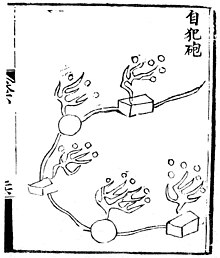

Starting in the ninth century, the Chinese began centuries of experiments that resulted in gunpowder, an explosive mixture of sulfur, charcoal and potassium nitrate. Gunpowder was first used in battle in the thirteenth century. An "enormous bomb", credited to Lou Qianxia, was used in 1277 by the Chinese at the Battle of Zhongdu,[14] although it probably had little effect. Gunpowder was difficult to use in mines because it is hygroscopic, easily absorbing water from the atmosphere, and when wet it is no longer explosive.[15]
A 14th-century military treatise, the Huolongjing (fire dragon manual), describes hollow cast iron cannonball shells filled with gunpowder.[16] The wad of the mine was made of hard wood, carrying three different fuses in case of defective connection to the touch hole. These fuses were long and lit by hand, so they required carefully timed calculations of enemy movements.[14]
The Huolongjing also describes land mines that were set off by enemy movement. A nine-foot length of bamboo was waterproofed by wrapping it in cowhide and covering it with oil. It was filled with compressed gunpowder and lead or iron pellets, sealed with wax and concealed in a trench.[14] The triggering mechanism was not fully described until the early 17th century. When the enemy stepped onto hidden boards, they dislodged a pin, causing a weight to fall. A cord attached to the weight was wrapped around a drum attached to two steel wheels; when the weight fell, the wheels struck sparks against flint, igniting a set of fuses leading to multiple mines. A similar mechanism was used in the first wheellock musket in Europe as sketched by Leonardo da Vinci around 1500 AD.[17]
Another victim-operated device was the "underground sky-soaring thunder", which lured bounty hunters with halberds, pikes, and lances planted in the ground. If they pulled on one of these weapons, the butt end disturbed a bowl underneath and a slow-burning incandescent material in the bowl ignited the fuses.[18][19]
The fuse mechanisms for the above devices were cumbersome and unreliable.[15] By the time Europeans arrived in China, landmines were largely forgotten.[20]
Europe and the United States
At Augsburg in 1573, three centuries after the Chinese invented the first pressure-operated mine, a German military engineer by the name of Samuel Zimmermann invented the Fladdermine (flying mine). It consisted of a few pounds of black powder buried near the surface and was activated by stepping on it or tripping a wire that made a flintlock fire. Such mines were deployed on the slope in front of a fort. They were used during the Franco-Prussian War, but were probably not very effective because a flintlock does not work for long when left untended.[15][20]
Another device, the fougasse, was not victim-operated or mass-produced, but it was a precursor of modern fragmentation mines and the claymore mine. It consisted of a cone-shape hole with gunpowder at the bottom, covered either by rocks and scrap iron (stone fougasse) or mortar shells, similar to large black powder hand grenades (shell fougasse). It was triggered by a flintlock connected to a tripwire on the surface. It could sometimes cause heavy casualties but required high maintenance due to the susceptibility of black powder to dampness. Consequently, it was mainly employed in the defenses of major fortifications, in which role it used in several European wars of the eighteenth century and the American Revolution.[20]
One of the greatest limitations of early land mines was the unreliable fuses and their susceptibility to dampness. This changed with the invention of the safety fuse. Later, command initiation, the ability to detonate a charge immediately instead of waiting several minutes for a fuse to burn, became possible after electricity was developed. An electrical current sent down a wire could ignite the charge with a spark. The Russians claim first use of this technology in the Russo-Turkish War of 1828–1829, and with it the fougasse remained useful until it was superseded by the claymore in the 1960s.[15]
Victim-activated mines were also unreliable because they relied on a flintlock to ignite the explosive. The percussion cap, developed in the early 19th century, made them much more reliable, and pressure-operated mines were deployed on land and sea in the Crimean War(1853–1856).[15]
During the American Civil War, the Confederate brigadier general Gabriel J. Rains deployed thousands of "torpedoes" consisting of artillery shells with pressure caps, beginning with the Battle of Yorktown in 1862. As a captain, Rains had earlier employed explosive booby traps during the Seminole Wars in Florida in 1840.[21][20] Over the course of the war, mines only caused a few hundred casualties, but they had a large effect on morale and slowed down the advance of Union troops.[22] Many on both sides considered the use of mines barbaric, and in response, generals in the Union Armyforced Confederate prisoners to remove the mines.[15]
High explosives
Starting in the 19th century, more powerful explosives than gunpowder were developed, often for non-military reasons such as blasting train tunnels in the Alps and Rockies. Guncotton, up to four times more powerful than gunpowder, was invented by Christian Schonbein in 1846. It was dangerous to make until Frederick Augustus Abel developed a safe method in 1865. From the 1870s to the First World War, it was the standard explosive used by the British military.[6]
In 1847, Ascanio Sobrero invented nitroglycerine to treat angina pectoris and it turned out to be a much more powerful explosive than guncotton. It was very dangerous to use until Alfred Nobel found a way to incorporate it in a solid mixture called dynamite and developed a safe detonator. Even then, dynamite needed to be stored carefully or it could form crystals that detonated easily. Thus, the military still preferred guncotton.[6]
In 1863, the German chemical industry developed trinitrotoluene (TNT). This had the advantage that it was difficult to detonate, so it could withstand the shock of firing by artillery pieces. It was also advantageous for land mines for several reasons: it was not detonated by the shock of shells landing nearby; it was lightweight, unaffected by damp, and stable under a wide range of conditions; it could be melted to fill a container of any shape, and it was cheap to make. Thus, it became the standard explosive in mines after the First World War.[6]
Between the American Civil War and the First World War
The British used mines in the Siege of Khartoum to hold off a much larger Sudanese Mahdist force for ten months. In the end, however, the town was taken and the British massacred. In the Boer War (1899–1903), they succeeded in holding Mafeking against Boer forces with the help of a mixture of real and fake minefields; and they laid mines alongside railroad tracks to discourage sabotage.[6]
In the Russo-Japanese War of 1904–1905, both sides used land and sea mines, although the effect on land mainly affected morale. The naval mines were far more effective, destroying several battleships.[6]
First World War
One sign of the increasing power of explosives used in land mines was that, by the First World War, they burst into about 1,000 high-velocity fragments; in the Franco-Prussian War (1870), it had only been 20 to 30 fragments.[20]Nevertheless, antipersonnel mines were not a big factor in the war because machine guns, barbed wire and rapid-fire artillery were far more effective defenses. An exception was in Africa (now Tanzania and Namibia) where the warfare was much more mobile.[6]
Towards the end of the war, the British started to use tanks to break through trench defenses. The Germans responded with anti-tank gunsand mines. Improvised mines gave way to mass-produced mines consisting of wooden boxes filled with guncotton, and minefields were standardized to stop masses of tanks from advancing.[6]
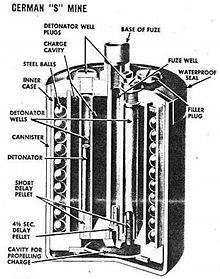
Between world wars, the future Allies did little work on land mines, but the Germans developed a series of anti-tank mines, the Tellermines (plate mines). They also developed the Schrapnell mine (also known as the S-mine), the first bounding mine. When triggered, this jumped up to about waist height and exploded, sending thousands of steel balls in all directions.[6][20] Triggered by pressure, trip wires or electronics,[6] it could harm soldiers within an area of about 2,800 square feet.[23]
Second World War

Tens of millions of mines were laid in the Second World War, particularly in the deserts of North Africa and the steppes of Eastern Europe, where the open ground favored tanks. However, the first country to use them was Finland. They were defending against a much larger Soviet force with over 6,000 tanks, twenty times the number the Finns had; but they had terrain that was broken up by lakes and forests, so tank movement was restricted to roads and tracks. Their defensive line, the Mannerheim Line, integrated these natural defenses with mines, including simple fragmentation mines mounted on stakes.[20]
While the Germans were advancing rapidly using blitzkrieg tactics, they did not make much use of mines. After 1942, however, they were on the defensive and became the most inventive and systematic users of mines. Their production shot up and they began inventing new types of mines as the Allies found ways to counter the existing ones. To make it more difficult to remove antitank mines, they surrounded them with S-mines and added anti-handling devices that would explode when soldiers tried to lift them. They also took a formal approach to laying mines and they kept detailed records of the locations of mines.[24][20]
In the Second Battle of El Alamein in 1942, the Germans prepared for an Allied attack by laying about half a million mines in two fields running across the entire battlefield and five miles deep. Nicknamed the "Devil's gardens", they were covered by 88 mm anti-tank gunsand small-arms fire. The Allies prevailed, but at the cost of over half their tanks; 20 percent of the losses were caused by mines.[25]
The Soviets learned the value of mines from their war with Finland, and when Germany invaded, they made heavy use of them, manufacturing over 67 million. At the Battle of Kursk, which put an end to the German advance, they laid over a million mines in eight belts with an overall depth of 35 kilometres.[24]
Mines forced tanks to slow down and wait for soldiers to go ahead and remove the mines. The main method of breaching minefields involved prodding the dirt with a bayonet or stick at an angle of 30 degrees (to avoid putting pressure on the top of the mine and detonating it). Since all mines at the beginning of the war had metal casings, metal detectors could be used to speed up the locating of mines. A Polish officer, Józef Kosacki, developed a portable mine detector known as the Polish mine detector. To counter the detector, Germans developed mines with wooden casings, the Schu-mine 42(antipersonnel) and Holzmine 42 (anti-tank). Effective, cheap and easy to make, the schumine became the most common mine in the war. Mine casings were also made of glass, concrete and clay. The Russians developed a mine with a pressed-cardboard casing, the PMK40, and the Italians made an anti-tank mine out of bakelite. In 1944, the Germans created the Topfmine, an entirely non-metallic mine. They ensured that they could detect their own mines by covering them with radioactive sand, but the Allies did not find this out until after the war.[24]
Several mechanical methods for clearing mines were tried. Heavy rollers attached to tanks or cargo trucks, but they did not last long and their weight made the tanks considerably slower. Tanks and bulldozers pushed ploughs that in turn pushed aside any mines to a depth of 30 cm. The Bangalore torpedo, a long thin tube filled with explosives, was invented in 1912 and used to clear barbed wire. Larger versions such as the Snake and the Conger were developed but were not very effective. One of the best options was the flail, which chains with weights on the end attached to rotating drums. The first version, the Scorpion, was attached to the Matilda tank and used in the Second Battle of El Alamein. The Crab, attached to the Sherman tank, was faster (2 kilometers per hour); it was used during D-Day and the aftermath.[24]
Cold War

During the Cold War, the members of NATO were concerned about massive armored attacks by the Soviet Union. They planned for a minefield stretching across the entire West German border, and developed new types of mine. The British designed an anti-tank mine, the Mark 7, to defeat rollers by detonating the second time it was pressed. It also had a 0.7-second delay so the tank would be directly over the mine. They also developed the first scatterable mine, the No. 7 ("Dingbat"). The Americans used the M6 antitank mine and tripwire-operated bounding antipersonnel mines such as the M2 and M16.[26]
In the Korean War, land mine use was dictated by the steep terrain, narrow valleys, forest cover and lack of developed roads. This made tanks less effective and more easily stopped by mines. However, mines laid near roads were often easy to spot. In response to this problem, the US developed the M24, a mine that was placed off to the side of the road. When triggered by a tripwire, it fired a rocket. However, the mine was not available until after the war.[26]
The Chinese had a lot of success with massed infantry attacks. The extensive forest cover limited the range of machine guns, but anti-personnel mines were effective. However, mines were poorly recorded and marked, often becoming as much a hazard to allies as enemies. Tripwire-operated mines were not defended by pressure mines; the Chinese were often able to disable them and reuse them against UN forces.[26]
Looking for more destructive mines, the Americans developed the Claymore, a directional fragmentation mine that hurls steel balls in a 60-degree arc at a lethal speed of 1,200 metres per second. They also developed a pressure-operated mine, the M14("toe-popper"). These, too, were ready too late for the Korean war.[26]

In 1948, the British developed the No. 6 antipersonnel mine, a minimum-metal mine with a narrow diameter, making it difficult to detect with metal detectors or prodding. Its three-pronged pressure piece inspired the nickname "carrot mine". However, it was unreliable in wet conditions. In the 1960s the Canadians developed a similar, but more reliable mine, the C3A1 ("Elsie") and the British army adopted it. The British also developed the L9 bar mine, a wide anti-tank mine with a rectangular shape, which covered more area, allowing a minefield to be laid four times as fast as previous mines. They also upgraded the Dingbat to the Ranger, a plastic mine that was fired from a truck-mounted discharger that could fire 72 mines at a time.[26]
In the 1950s, the US Operation Doan Brook studied the feasibility of delivering mines by air. This led to three types of air-delivered mine. Wide area anti-personnel mines(WAAPMs) were small steel spheres that discharged tripwires when they hit the ground; each dispenser held 540 mines. The BLU-43 Dragontooth was small and had a flattened Wshape to slow its descent, while the gravel mine was larger. Both were packed by the thousand into bombs. All three were designed to inactivate after a period of time, but any that failed to activate presented a safety challenge. Over 37 million Gravel mines were produced between 1967 and 1968, and when they were dropped in places like Vietnam their locations were unmarked and unrecorded. A similar problem was presented by unexploded cluster munitions.[26]
The next generation of scatterable mines arose in response to the increasing mobility of war. The Germans developed the Skorpion system, which scattered AT2 mines from a tracked vehicle. The Italians developed a helicopter delivery system that could rapidly switch between SB-33 anti-personnel minesand SB-81 anti-tank mines. The US developed a range of systems called the Family of Scatterable Mines (FASCAM) that could deliver mines by fast jet, artillery, helicopter and ground launcher.[26]
Middle eastern conflicts
The Iraq-Iran War, the Gulf War, and the Islamic State have all contributed to land mine saturation in Iraq from the 1980s through 2020. Iraq is now the most saturated country in the world with landmines.[27] Countries that provided land mines during the Iran-Iraq War included Belgium, Canada, Chile, China, Egypt, France, Italy, Romania, Singapore, the former Soviet Union and the U.S., and were concentrated in the Kurdish areas in the northern area of Iraq. During the Gulf War, the U.S. deployed 117,634 mines, with 27,967 being anti-personnel mines and 89,667 being anti-vehicle mines.[28] The U.S. did not use land mines during the Iraq War.[29]
Invasion of Ukraine
Both sides have used land mines. Ukraine uses anti-tank mines. Russia, like the US, are exempt from the 1997 ban on anti-personal land mines. Russian forces has been accused of leaving behind land mines totalling 54,000. In areas where Ukrainian forces have pushed back Russian forces. Or Russian forces have withdrawn they have left anti-personal mines behind.
Ukrainian forces have found land mines under corpses, hospital beds, in door ways, inside cars, washing machines, refrigerators to name a few places. [30]
Some 550 bomb disposal experts are deployed prior to civilians going back to their homes. Given their random placements land mines can be found anywhere. Locals are urged to get the emergency services to check their homes before they enter. The use of land mines to slow an advancing force is nothing new, however Russian forces have a history of targeting civilians. [31]
Some of these land mines are deployed by artillery or rocket launcher. Human Rights Watch in particular points out the POM-3 as a new mine also called ‘Medallion’. It entered service in 2021. Once fired it has a range of 5-15 kms. It then deploys via parachute and has seismic sensor. Once a person approaches it will explode sending shrapnel at the target. It apparently has a self destruct that detonates if no one triggers it. HRW accuse Russia of involvement in: “30 countries, including in Syria (2011-2019), Ukraine (2014-2015), and Libya (2020).” [32]
Chemical and nuclear
In the First World War, the Germans developed a device, nicknamed the "Yperite Mine" by the British, that they left behind in abandoned trenches and bunkers. It was detonated by a delayed charge, spreading mustard gas ("Yperite"). In the Second World War they developed a modern chemical mine, the Sprüh-Büchse 37 (Bounding Gas Mine 37), but never used it.[20] The United States developed the M1 chemical mine , which used mustard gas, in 1939; and the M23 chemical mine, which used the VX nerve agent, in 1960.[33] The Soviets developed the KhF, a "bounding chemical mine".[34] The French had chemical mines and the Iraqis were believed to have them before the invasion of Kuwait.[35]In 1997, the Chemical Weapons Conventioncame into force, prohibiting the use of chemical weapons and mandating their destruction. As of April 30, 2019, 97% of the declared stockpiles of chemical weapons were destroyed.[36]
For a few decades during the Cold War, the U.S. developed atomic demolition munitions, often referred to as nuclear land mines. These were portable nuclear bombs that could be placed by hand, and could be detonated remotely or with a timer. Some of these were deployed in Europe. Governments in West Germany, Turkey and Greece wanted to have nuclear minefields as a defense against attack from the Warsaw Pact. However, such weapons were politically and tactically infeasible, and by 1989 the last of these munitions was retired.[37][38] The British also had a project, codenamed Blue Peacock, to develop nuclear mines to be buried in Germany; the project was cancelled in 1958.[39][40]
Characteristics and function
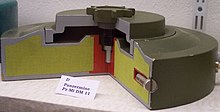
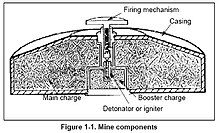
A conventional land mine consists of a casing that is mostly filled with the main charge. It has a firing mechanism such as a pressure plate; this triggers a detonator or igniter, which in turn sets off a booster charge. There may be additional firing mechanisms in anti-handling devices.[41]
Firing mechanisms and initiating actions
A land mine can be triggered by a number of things including pressure, movement, sound, magnetism and vibration.[41] Anti-personnel mines commonly use the pressure of a person's foot as a trigger, but tripwires are also frequently employed. Most modern anti-vehicle mines use a magnetic trigger to enable it to detonate even if the tires or tracks did not touch it. Advanced mines are able to sense the difference between friendly and enemy types of vehicles by way of a built-in signature catalog. This will theoretically enable friendly forces to use the mined area while denying the enemy access.
Many mines combine the main trigger with a touch or tilt trigger to prevent enemy engineers from defusing it. Land mine designs tend to use as little metal as possible to make searching with a metal detector more difficult; land mines made mostly of plastic have the added advantage of being very inexpensive.
Some types of modern mines are designed to self-destruct, or chemically render themselves inert after a period of weeks or months to reduce the likelihood of civilian casualties at the conflict's end. These self-destruct mechanisms are not absolutely reliable, and most land mines laid historically are not equipped in this manner.
There is a common misperception that a landmine is armed by stepping on it and only triggered by stepping off, providing tension in movies.[42] In fact the initial pressure trigger will detonate the mine, as they are designed to kill or maim, not to make someone stand very still until it can be disarmed.
Anti-handling devices

Anti-handling devices detonate the mine if someone attempts to lift, shift or disarm it. The intention is to hinder deminers by discouraging any attempts to clear minefields. There is a degree of overlap between the function of a boobytrap and an anti-handling device insofar as some mines have optional fuze pockets into which standard pull or pressure-release boobytrap firing devices can be screwed. Alternatively, some mines may mimic a standard design, but actually be specifically intended to kill deminers, such as the MC-3 and PMN-3 variants of the PMN mine. Anti-handling devices can be found on both anti-personnel mines and anti-tank mines, either as an integral part of their design or as improvised add-ons. For this reason, the standard render safe procedure for mines is often to destroy them on site without attempting to lift them.
Anti-tank mines
Anti-tank mines were created not long after the invention of the tank in the First World War. At first improvised, purpose-built designs were developed. Set off when a tank passes, they attack the tank at one of its weaker areas – the tracks. They are designed to immobilize or destroy vehicles and their occupants. In U.S. military terminology destroying the vehicles is referred to as a catastrophic kill while only disabling its movement is referred to as a mobility kill.
Anti-tank mines are typically larger than anti-personnel mines and require more pressureto detonate. The high trigger pressure, normally requiring 100 kilograms (220 lb) prevents them from being set off by infantryor smaller vehicles of lesser importance. More modern anti-tank mines use shaped charges to focus and increase the armor penetration of the explosives.
Anti-personnel mines

Anti-personnel mines are designed primarily to kill or injure people, as opposed to vehicles. They are often designed to injure rather than kill to increase the logistical support (evacuation, medical) burden on the opposing force. Some types of anti-personnel mines can also damage the tracks or wheels of armored vehicles.
In the asymmetric warfare conflicts and civil wars of the 21st century, improvised explosives, known as IEDs, have partially supplanted conventional landmines as the source of injury to dismounted (pedestrian) soldiers and civilians. IEDs are used mainly by insurgents and terrorists against regular armed forces and civilians. The injuries from the anti-personnel IED were recently reported in BMJ Open to be far worse than with landmines resulting in multiple limb amputations and lower body mutilation.[43]