Amphibious warfare is a type of offensivemilitary operation that today uses naval shipsto project ground and air power onto a hostile or potentially hostile shore at a designated landing beach.[1] Through history the operations were conducted using ship's boatsas the primary method of delivering troops to shore. Since the Gallipoli Campaign, specialised watercraft were increasingly designed for landing troops, material and vehicles, including by landing craft and for insertion of commandos, by fast patrol boats, zodiacs (rigid inflatable boats) and from mini-submersibles.

The term amphibious first emerged in the United Kingdom and the United States during the 1930s with introduction of vehicles such as Vickers-Carden-Loyd Light Amphibious Tank or the Landing Vehicle Tracked.[note 1]
Amphibious warfare includes operations defined by their type, purpose, scale and means of execution. In the British Empire at the time these were called combined operations which were defined as "...operations where naval, military or air forces in any combination are co-operating with each other, working independently under their respective commanders, but with a common strategic object."[2] All armed forces that employ troops with special training and equipment for conducting landings from naval vessels to shore agree to this definition.
Since the 20th century an amphibious landing of troops on a beachhead is acknowledged as the most complex of all military maneuvers. The undertaking requires an intricate coordination of numerous military specialties, including air power, naval gunfire, naval transport, logistical planning, specialized equipment, land warfare, tactics, and extensive training in the nuances of this maneuver for all personnel involved.
Operation

In essence, amphibious operations consist of the phases of strategic planning and preparation, operational transit to the intended theatre of operations, pre-landing rehearsal and disembarkation, troop landings, beachhead consolidation and conducting inland ground and air operations. Historically, within the scope of these phases a vital part of success was often based on the military logistics, naval gunfire and close air support. Another factor is the variety and quantity of specialised vehicles and equipment used by the landing force that are designed for the specific needs of this type of operation.
Amphibious operations can be classified as tactical or operational raids such as the Dieppe Raid, operational landings in support of a larger land strategy such as the Kerch–Eltigen Operation, and a strategic opening of a new Theatre of Operations, for example the Operation Avalanche.
The purpose of amphibious operations is usually offensive, except in cases of amphibious withdrawals, but is limited by the plan and terrain. Landings on islands less than 5,000 km2 (1,900 sq mi) in size are tactical, usually with the limited objectives of neutralising enemy defenders and obtaining a new base of operation. Such an operation may be prepared and planned in days or weeks, and would employ a naval task force to land less than a division of troops.

The intent of operational landings is usually to exploit the shore as a vulnerability in the enemy's overall position, forcing redeployment of forces, premature use of reserves, and aiding a larger allied offensive effort elsewhere. Such an operation requiring weeks to months of preparation and planning, would use multiple task forces, or even a naval fleet to land corps-size forces, including on large islands, for example Operation Chromite. A strategic landing operation requires a major commitment of forces to invade a national territory in the archipelagic, such as the Battle of Leyte, or continental, such as Operation Neptune. Such an operation may require multiple naval and air fleets to support the landings, and extensive intelligence gathering and planning of over a year.
Although most amphibious operations are thought of primarily as beach landings, they can exploit available shore infrastructure to land troops directly into an urban environment if unopposed. In this case non-specialised ships can offload troops, vehicles and cargo using organic or facility wharf-side equipment. Tactical landings in the past have utilised small boats, small craft, small ships and civilian vessels converted for the mission to deliver troops to the water's edge.
Preparation and planning
Preparation and planning the naval landing operation requires the assembly of vessels with sufficient capacity to lift necessary troops employing combat loading. It can also include conducting amphibious reconnaissance. The military intelligence services produce a briefing on the expected opponent which guides the organisation and equipping of the embarked force. First specially designed landing craft were used for the Gallipoli landings, and armoured tracked vehicles were also available for the Guadalcanal Campaign. Helicopters were first used to support beach landings during Operation Musketeer.
Hovercraft have been in use for naval landings by military forces since the 1960s.
Origins
Recorded amphibious warfare goes back to ancient times. The Sea Peoples menaced the Egyptians from the reign of Akhenaten as captured on the reliefs at Medinet Habu and Karnak.
The Hellenic city states routinely resorted to opposed assaults upon each other's shores, which they reflected upon in their plays and other expressions of art. The landing at Marathon by the ancient Persians on 9 September 490 BC, was the largest amphibious operation until it was eclipsed by the landings at the Battle of Gallipoli.
Marines

In 1565, the island of Malta was invaded by the Ottoman Turks during the Great Siege of Malta, forcing its defenders to retreat to the fortified cities. A strategic choke point in the Mediterranean Sea, its loss would have been so menacing for the Western Europeankingdoms that forces were urgently raised in order to relieve the island. But it took four months to train, arm, and move a 5,500-man amphibious force to lift the siege.
Then, Philip II, King of Spain decided to train and assign amphibious-assault skilled units to the Royal Armada. These units were trained specifically for fighting on and from ships. The Spanish Marines were born. The idea was to set up a permanent assignation of land troops to the Royal Spanish Navy, available for the Crown.
Thus other countries adopted the idea and subsequently raised their own, early marine forces as well.
The first "professional" marine units were already task-trained amphibious troops, but instead of being disbanded, were kept for the Spanish Crown's needs. Their first actions took place all along the Mediterranean Sea where the Turks and pirate settlements were a risk for commerce and navigation: Algiers, Malta, Gelves.
The "Terceras Landing" in the Azores Islands on 25 May 1583, was a military feat as its planners decided to make a fake landing to distract the defending forces (5,000 Portuguese, English and French soldiers); also special seagoing barges were arranged in order to unload cavalry horses and 700 artillery pieces on the beach; special rowing boats were armed with small cannons to support the landing boats; special supplies were readied to be unloaded and support the 11,000-man landing force strength. The total strength of the amphibious force was 15,000 men, including an armada of 90 ships.
Development
From the 15th to the 20th centuries, several European countries established and expanded overseas colonies. Amphibious operations mostly aimed to settle colonies and to secure strong points along navigational routes. Amphibious forces were fully organized and devoted to this mission,[citation needed] although the troops not only fought ashore, but on board ships.
By their nature amphibious assaults involve highly complex operations, demanding the coordination of disparate elements; therefore disastrous results can ensue from insufficient planning. One of the most spectacular instances of such a failure occurred in 1741 at the Battle of Cartagena de Indias in New Granada, when a large British amphibious assault force with a divided command failed to overcome a much smaller but heavily fortified Spanish defence. Twenty years later, in 1762, a similar British force successfully landed at Havana in Cuba, besieged the city and captured it after a two-month campaign thanks to improved coordination of land and sea forces.[citation needed]
A major amphibious landing took place during the Siege of Quebec in 1759, as part of the Seven Years' War. The British produced the first specially designed landing-craft in order to enable their troops to cross the Saint Lawrence River in force. After considering and rejecting a number of plans for landings on the north shore of the river, General James Wolfe and his brigadiers decided in late August to land upriver of the city.[3]
The British prepared for their risky deployment upstream. Troops had already been aboard landing ships and drifting up and down the river for several days when on 12 September Wolfe made a final decision on the British landing site, selecting L'Anse-au-Foulon. Wolfe's plan of attack depended on secrecy and surprise — a key element of a successful amphibious operation — a small party of men would land by night on the north shore, climb the tall cliff, seize a small road, and overpower the garrison that protected it, allowing the bulk of his army (5,000 men) to ascend the cliff by the small road and then deploy for battle on the plateau.[4] The operation proved a success, leading to the surrender of the city, and heavily influenced subsequent engagements.

In 1762 British Royal Navy sailors and marines succeed in taking the capitals of the Spanish West and East Indies: Havana in Cuba and Manila in the Philippines respectively. In 1776 Samuel Nicholas and the Continental Marines, the "progenitor" of the United States Marine Corps, made a first successful landing in the Raid of Nassau in the Bahamas.
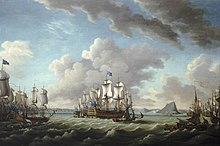
In 1782 The British rebuffed a long Franco-Spanish attempt to seize Gibraltar by water-borne forces. In 1783 a Franco-Spanish force invaded the British-held island of Minorca. In 1798 Minorca experienced yet another of its many changes of sovereignty when captured by a British landing.
As the British Empire expanded worldwide, four colonies (Halifax, in Nova Scotia; Bermuda; Gibraltar; and Malta) were designated Imperial fortresses,[5][6][7][8][9][10]from which Britain's domination of the oceans and the Mediterranean and Caribbean seas was maintained, including its ability to deny safe passage to enemy naval and merchant vessels while protecting its own merchant trade, as well as to its ability to project superior naval and military force anywhere on the planet. This was demonstrated during the American War of 1812, when the ships of the North America Station of the Royal Navy and military forces of the British Army, Board of Ordnance, and Royal Marines, maintained a blockade of much of the Atlantic seaboard of the United States of America, carried out amphibious raids such as the 22 June 1813 Battle of Craney Island,[11] and then launched the Chesapeake Campaign (defeating American forces in the Battle of Bladensburg, capturing and burning Washington, DC, and raiding Alexandria, Virginia),[12][13] from Bermuda.
Industrial era

In the Mexican-American War, US forces under Winfield Scott launched the first major amphibious assault in US history in the 1847 Siege of Veracruz. During the Crimean War of 1853-1856 the anti-Russian alliance launched an Anglo-French amphibious operation against Russia at Bomarsund, Finland on 8 August 1854. During the American Civil War of 1861-1865 the United States made several amphibious assaults along the coastlines of the Confederate States. Actions at Hatteras Inlet (August 1861) and at Port Royal, South Carolina were the first of many attacks, others occurring on Roanoke Island, NC; Galveston, TX; Fort Sumter, Morris Island and James Island, SC; and several more. The largest such clash happened in January 1865 at Fort Fisher - the largest and most powerful fort in the world at the time - which protected the entrance of Wilmington, North Carolina. The assaulting force consisted of over 15,000 men and 70 warships with over 600 guns.
During the American Civil War, the Mississippi Marine Brigade was established to act swiftly against Confederate forces operating near the Mississippi River and its tributaries. The unit consisted of artillery, cavalry and infantry with the United States Ram Fleet used as transportation.[14]
Amphibious warfare during the War of the Pacific of 1879 to 1883 saw coordination of army, navy and specialized units. The first amphibious assault of this war took place during the Battle of Pisagua when 2,100 Chilean troops successfully took Pisaguafrom 1,200 Peruvian and Bolivian defenders on 2 November 1879. Chilean Navy ships bombarded beach defenses for several hours at dawn,[citation needed] followed by open, oared boats landing army infantry and sapper units into waist-deep water, under enemy fire. An outnumbered first landing-wave fought at the beach; the second and third waves in the following hours succeeded in overcoming resistance and moving inland. By the end of the day, an expeditionary army of 10,000 had disembarked at the captured port.

In 1881 Chilean ships transported approximately 30,000 men, along with their mounts and equipment, 500 miles (800 km) in order to attack Lima.[15] Chilean commanders commissioned purpose-built, flat-bottomed landing craft that would deliver troops in shallow water closer to the beach, possibly[original research?] the first purpose-built amphibious landing-craft in history:[16] "These [36 shallow draft, flat-bottomed] boats would be able to land three thousand men and twelve guns in a single wave".
Neutral military observers closely studied landing tactics and operations during the War of the Pacific: two Royal Navy ships monitored the Battle of Pisagua; United States Navyobserver Lt. Theodorus B. M. Mason included an account in his report The War on the Pacific Coast of South America. The USS Wachusettwith Alfred Thayer Mahan in command, was stationed at Callao, Peru, protecting American interests during the final stages of the War of the Pacific. He formulated his concept of sea power while reading a history book in an English gentleman's club in Lima, Peru. This concept became the foundation for his celebrated The Influence of Sea Power upon History (1890).[17][18]
An amphibious assault took place on the beaches of Veracruz, Mexico in 1914, when the United States Navy attacked and occupied the city as result of the Tampico Affair.